
Greater Norwich Local Plan
This page contains selected excerpts from the Greater Norwich Local Plan, focusing on policies which make reference to Norwich’s Conservation Areas.
2. Greater Norwich Profile
Environmental Assets
The Built and Historic Environment
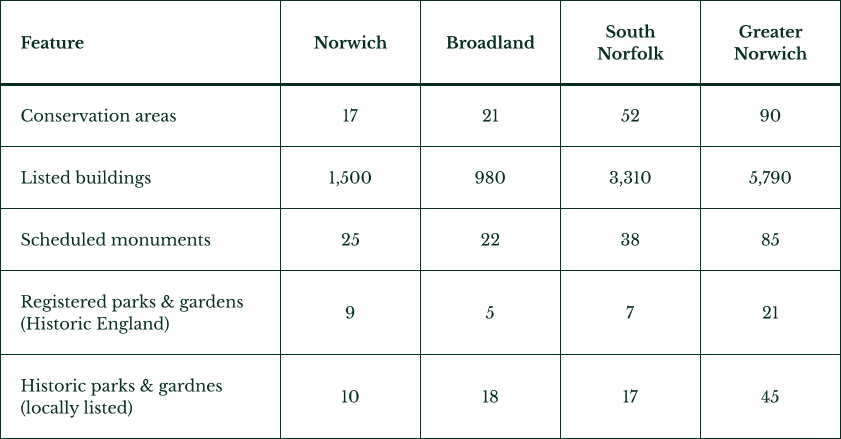
110 - 113. Greater Norwich has a rich concentration of heritage assets. At its core is the City of Norwich, formerly England’s second city, with its two cathedrals and many other historic buildings, including the greatest number of medieval churches in northern Europe, monastic halls, former merchants’ houses, the city wall and industrial heritage. The city centre’s current street pattern still broadly reflects these historic influences.. The city is linked to a hinterland of settlements which also have a rich heritage reflecting the area’s relative prosperity and high density of settlement through history, particularly prior to the industrial revolution.. Market towns, villages and hamlets show a pattern of development that has built up over the centuries, with a wealth of medieval churches, including a number of round tower churches, farmsteads and historic halls… In total, there are around 5,800 listed buildings and 90 Conservation Areas. Scheduled monuments and significant archaeological potential and historic landscape character, as defined in assessments, add a further layer to this historic character. It is important that the plan has policies to protect and enhance heritage, including heritage at risk.
Table 3: Numbers of Conservation Areas, Listed Buildings, Scheduled Monuments and Registered Park and Gardens
5. The Strategy (including policies)
Policy 3 Environmental Protection and Enhancement.
The Built and Historic Environment
181-183. The National Planning Policy Framework states that plans should set out a positive strategy for the conservation and enjoyment of the historic environment, including heritage assets most at risk through neglect, decay or other threats.. The Greater Norwich area has numerous heritage assets. Consequently, the historic environment is central to the character and quality of life of the Greater Norwich area and is a significant factor in its economic success through encouraging tourism and inward investment. Conserving and enhancing the historic environment will continue to reinforce what makes Greater Norwich an attractive place to live in, work and visit.. As well as the heritage assets that are easily visible, there are also those that are hidden below ground. As a long settled and productive area, Greater Norwich has a significant archaeological heritage which development can help to reveal.
184. As such, it is important to recognise that the historic character of the area is made up of a multitude of heritage assets. Individually, some may be more important than others, but even the lesser ones are important in contributing to overall character and quality. All the different elements of the historic environment need to be taken into consideration and conserved and enhanced where possible as part of the development of the area. Guidance for this can be obtained through a wide range of existing resources, such as historic landscape character assessments, conservation area appraisals, listed building and scheduled monuments information and archaeological records; but it is usually necessary to undertake a heritage impact assessment in accordance with guidelines produced by Historic England and local validation requirements to understand the impact of a proposal on the significance of a heritage asset. This would include the impact of development on the setting of a heritage asset, which can contribute to its significance, and can be undermined by proposals that have substantial mass or height that contrasts with neighbouring historic buildings and the wider area.
185-187. The strategic approach to heritage is first to consider the potential location of development, for example does the location itself “fit” well in relation to adjoining settlements, and does it avoid intruding in important views of heritage assets? This is addressed through the growth strategy set out in policy 1. Following from this, the design of the development needs to respect the historic environment, be appropriate to its setting, seek to enhance the locality and provide measures to further the understanding of local heritage issues. Development should therefore draw upon existing historic character to lead to more positive change in the built and historic environment. The aim should be to avoid harm to the historic environment. In certain cases, an element of harm to the historic environment resulting from development may be unavoidable. This will only be justified if the benefits of the development outweigh the harm, and the harm is kept to a minimum, taking into account the relative importance of the heritage assets in accordance with national policy.
188-189. The policy also includes a flexible approach to the use of heritage assets to achieve their retention whilst retaining their historic significance, and in this respect particular encouragement will be given to proposals for restoring those assets that are at risk of being lost. Historic significance potentially covers a broad range of issues such as artistic, aesthetic, architectural, cultural and social considerations. The Greater Norwich Green Infrastructure Study provides information on designated Historic Environment assets in relation to green infrastructure provision.
Policy 3 Environmental Protection and Enhancement.
The Built and Historic Environment
The development strategy of the plan and the sites proposed for development reflect the area’s settlement structure of the city, towns and villages, retaining the separate identities of individual settlements.
Development proposals should enhance the built and historic environment through:
Being designed to create a distinct sense of place and enhance local character, taking account of local guidance such as conservation area appraisals and historic landscape character assessments.
Avoiding harm to designated and non-designated heritage assets, including their setting, having regard to their level of significance in accordance with the requirements of the NPPF and relevant policies in other Development Plan Documents and Neighbourhood Plans.
Providing a continued or new use for heritage assets whilst retaining their historic significance.
Undertaking a heritage impact assessment if significant impacts to a heritage asset might arise.
Where relevant, heritage interpretation measures should be provided to enhance the appreciation and understanding of local heritage assets
Conservation Area (definition in the Appendices): Area of special historic and/or architectural interest which is designated by the local planning authority as being important to conserve and enhance. Special planning controls apply within these areas.