
Historical background
Town Close Road is a unique heritage area.
Town Close Road and its adjacent lanes contain some 20 listed Grade II buildings and sits centrally within the Newmarket Road Conservation Area. Such a concentration and the consistency of unspoilt heritage properties from a single period is unique within Norwich. In central Norwich there are many fine streets, some dating back to medieval times and long before early Victorian construction began in the Town Close area. But few locations in the city have retained the homogeneity of Town Close Road. Furthermore, most of the plot boundaries and gardens here contain fine mature trees, many dating to the mid-nineteenth Century when these buildings were first constructed.
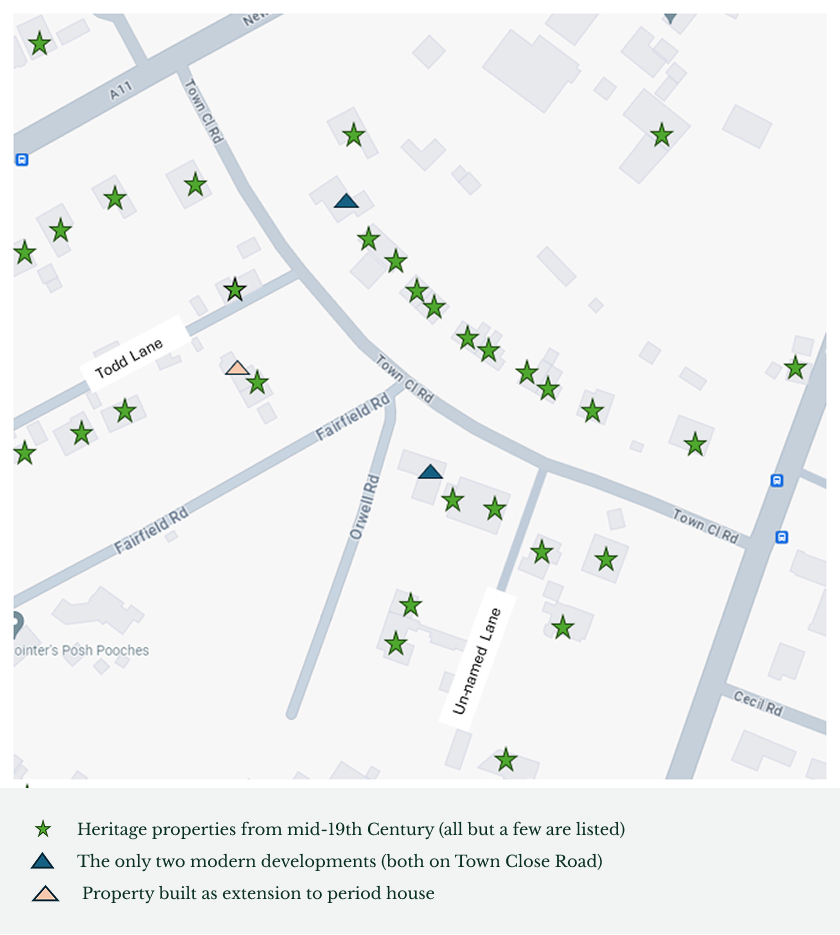
Most of the houses in Town Close Road are ‘pairs’ – two adjoining houses in one building. A typical English Heritage Listing for these houses reads along these lines:
“Pair of houses. Mid-19th Century with later alterations. Yellow brick; hipped slate roof; three brick ridge chimneys. Two storeys; seven to ten first-floor windows. Rusticated brick quoins. Each has a central panelled door with plain overlight in rendered architrave with plain hood on consoles, and in some cases rendered and glazed porch with dentilled cornice. Most have square-fronted ground-floor bay windows and canted ground-floor bays with full-height sashes to left of each unit. Other windows have sashes with glazing bars under flat gauged brick arches”.
[Text adapted from English Heritage listings which varies from house to house]
Heritage values identified
This commentary follows the methodology of ‘Conservation Principles, Policies and Guidance for the Sustainable Management of the Historic Environment, English Heritage 2018.
a) Evidential Value
The potential of a place to yield evidence about past human activity.
These period houses show ample evidence of the architecture of the Victorian expansion of Norwich in the 1850s, although the style is more recognisable as ‘Georgian’. Their layout and features, such as fireplaces, window furniture and doorways, continue to show how the house would have been occupied.
b) Historical value
How past people, events and aspects of life can be connected through a place to the present.
See Historical Development for the specific history of the building of the Town Close Estate in the 1850s. Although interiors have been modernised and conservatories often added at the rear, the front views from the street of these properties remain almost entirely unspoilt by subsequent modernisations.
c) Aesthetic value
The sensory and intellectual stimulation to be gained from a place.
These building are rich in design value – well-proportioned buildings with a garden to the back and front, containing some fine mature trees. In most properties many original features still exist, although over time some have been covered (such as fireplaces, floorboards), or lost (such as window furniture and doorknobs), or broken (fireplace inner sections, skirting boards). However, most owners have set out to recover many of these features or sensitively replace lost features with originals from the period.
a) Communal value
Meanings of a place for the people who relate to it or for whom it represents a collective experience of memory.
The residents of the heritage properties of Town Close Road and around appreciate that they are custodians of their current homes for future generations. Many have invested considerable savings into ensuring their homes and the fine mature trees are well maintained. Often this has meant restoring or exposing heritage features – in collaboration with the City Council’s Conservation Officer within the Planning Department when required. This website is a testament to the value placed on the heritage of this area and our determination to ensure any new development is sensitive to preserving these collective values.